English version of テーパネジにシールテープが不可欠な理由
Good evening, everyone.
Thank you for coming back to read again.
This time: “Why seal tape is essential on tapered threads.” It’s an everyday sight on almost every site — and looking closely at that “obvious” practice left me with something worth logging.
What is a tapered thread?
A tapered thread is a pipe thread whose major and minor diameters taper along the axis (typically 1/16).
JIS B 0203 PT (R/Rc), ISO 7, and in U.S. practice NPT/NPTF are representative examples. All of them aim at a primary seal through wedge engagement of the thread flanks — a sealing/fastening approach that is fundamentally different from parallel threads (parallel pipe threads, UN/UNF, etc.).
If the wording is hard to follow, the images below should make the idea clear.
##
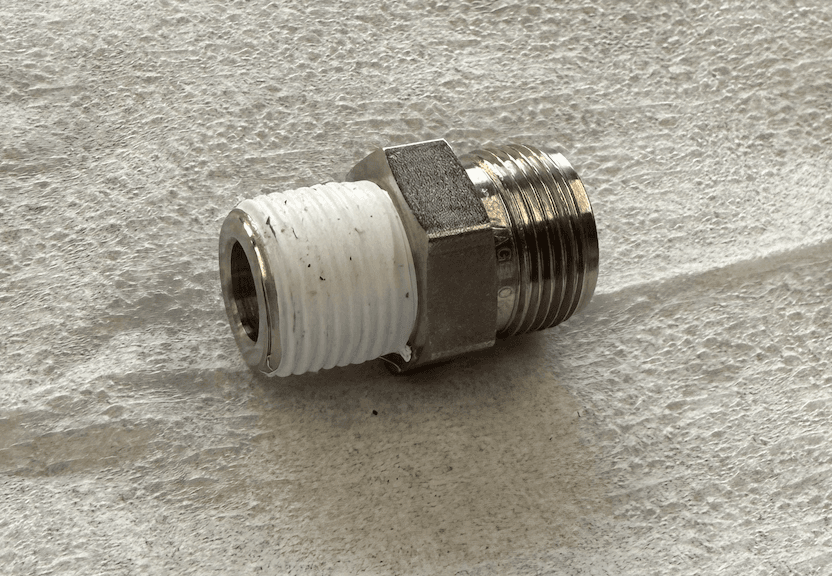
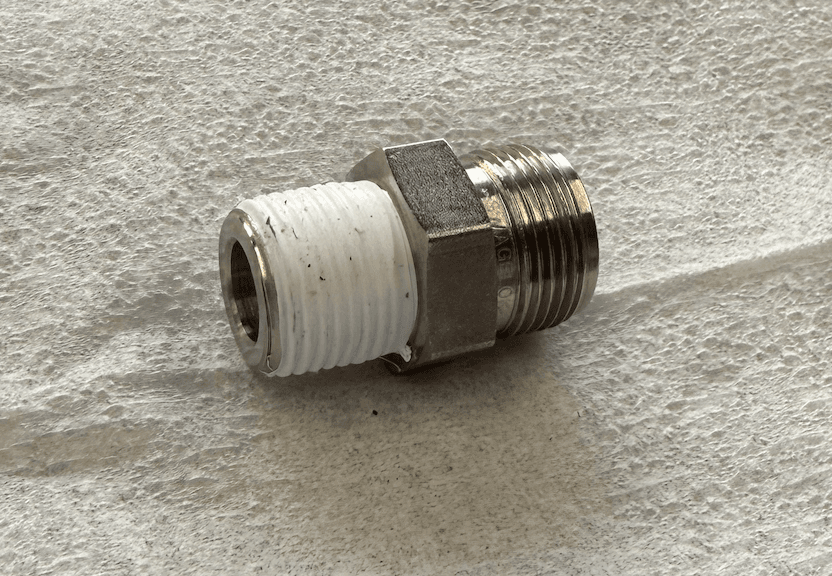
As in the thumbnail, this image shows a Swagelok fitting part — an adapter from Swagelok to taper.
The left side is taper, the right side is Swagelok; as noted above, that taper is standardized.
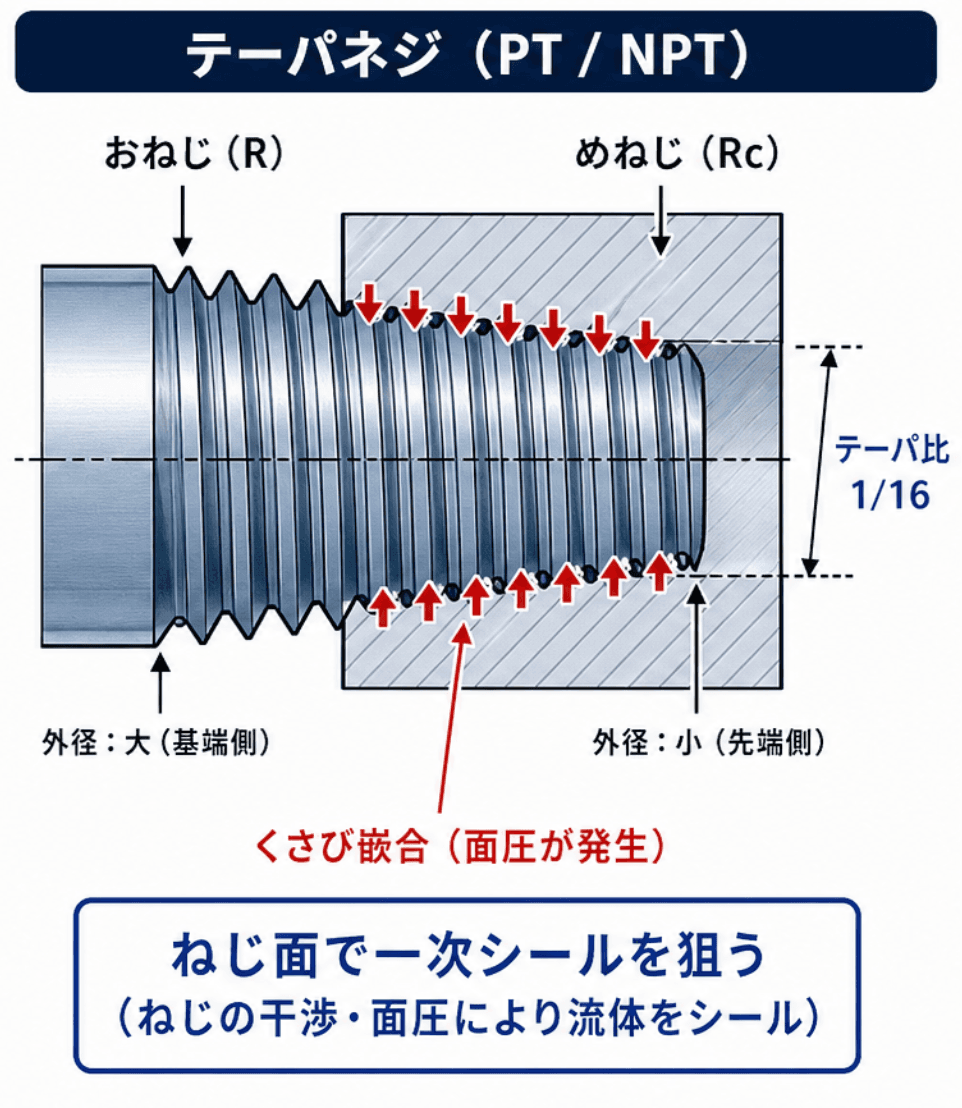
As the image shows, interference in this tapered threaded section is how piping systems large and small keep a seal.
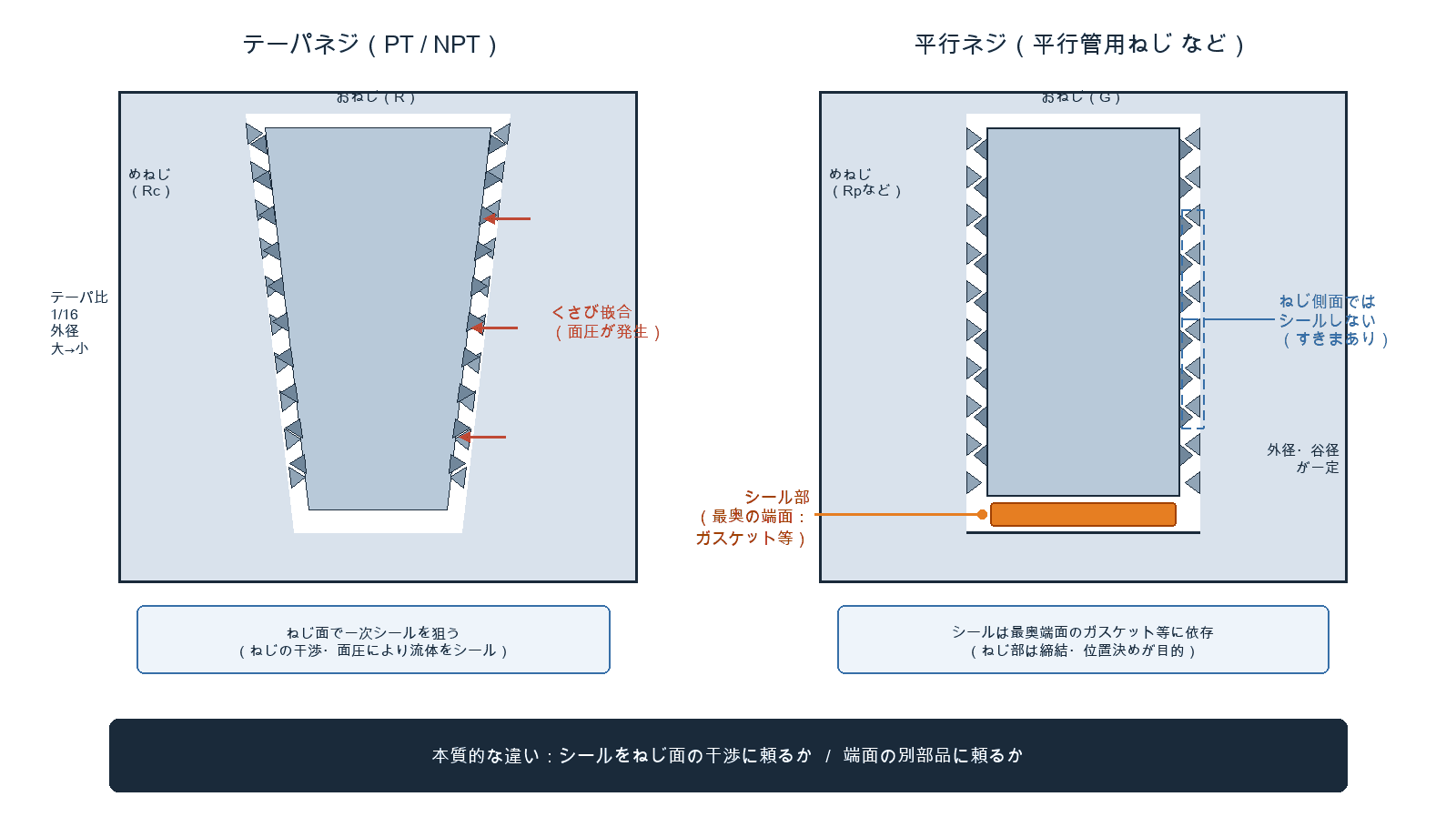
But is a seal really guaranteed by metal-to-metal contact alone?
Unfortunately, a tapered thread by itself barely seals.
The reasons include:
Dimensional tolerances differ subtly by manufacturer
Dense metal-to-metal contact occurs on the thread crests/flanks
That is where seal tape comes in.
Seal tape
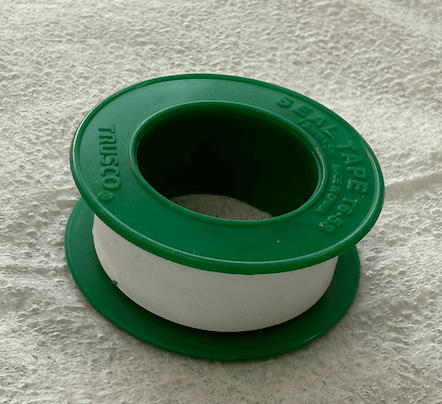
Enter seal tape from TRUSCO, which I rely on all the time.
The material is PTFE (polytetrafluoroethylene), a fluoropolymer also specified in JIS: it does not stick to metal, while tape layers stick to each other and stretch thin.
That lets it absorb manufacturer-to-manufacturer dimensional tolerance differences and stabilize make-up torque — which is why tapered threads are so widely used on sites today.
Summary
In aerospace, too, these joints are widely used on hydraulic, pneumatic, and fuel systems — but by standard, the design does not guarantee leak-tightness from metal interference alone.
Given scatter in thread accuracy, engagement length, and surface condition, secondary sealing with seal tape or sealant is the usual practice.
“PT” is a cross-industry familiar label — but remember: it is not “tighten and it won’t leak,” it is “add the sealing means the standard assumes.”
References / column
· https://kikakurui.com/b0/B0203-1999-01.html
PTFE characteristics
· Low yield stress
⇨ Under contact pressure it tends to flow plastically — and that flow absorbs scatter in tolerance, roughness, and engagement length.
· Self-lubricating
⇨ Helps suppress galling/seizing between threads during make-up. This property was also used in the LE-7 engine turbopump bearing retainer. (Makoto Yoshida, research on shaft vibration of the LE-7 LOX turbopump)
· Chemically inert
⇨ Nonpolar · chemical resistance · flame resistance, etc.
· Wide service temperature range
⇨ Endures long use from about −100°C to +260°C. Even if it briefly reaches decomposition temperature, charring does not start immediately.
· Water absorption
⇨ Essentially none
The PTFE-based material once used for bearing retainers reportedly can no longer be produced due to environmental issues...